
Laura Billings
-
Total Recruits5018 collected! 36.0% of the goal
-
Why Idle Off Matters
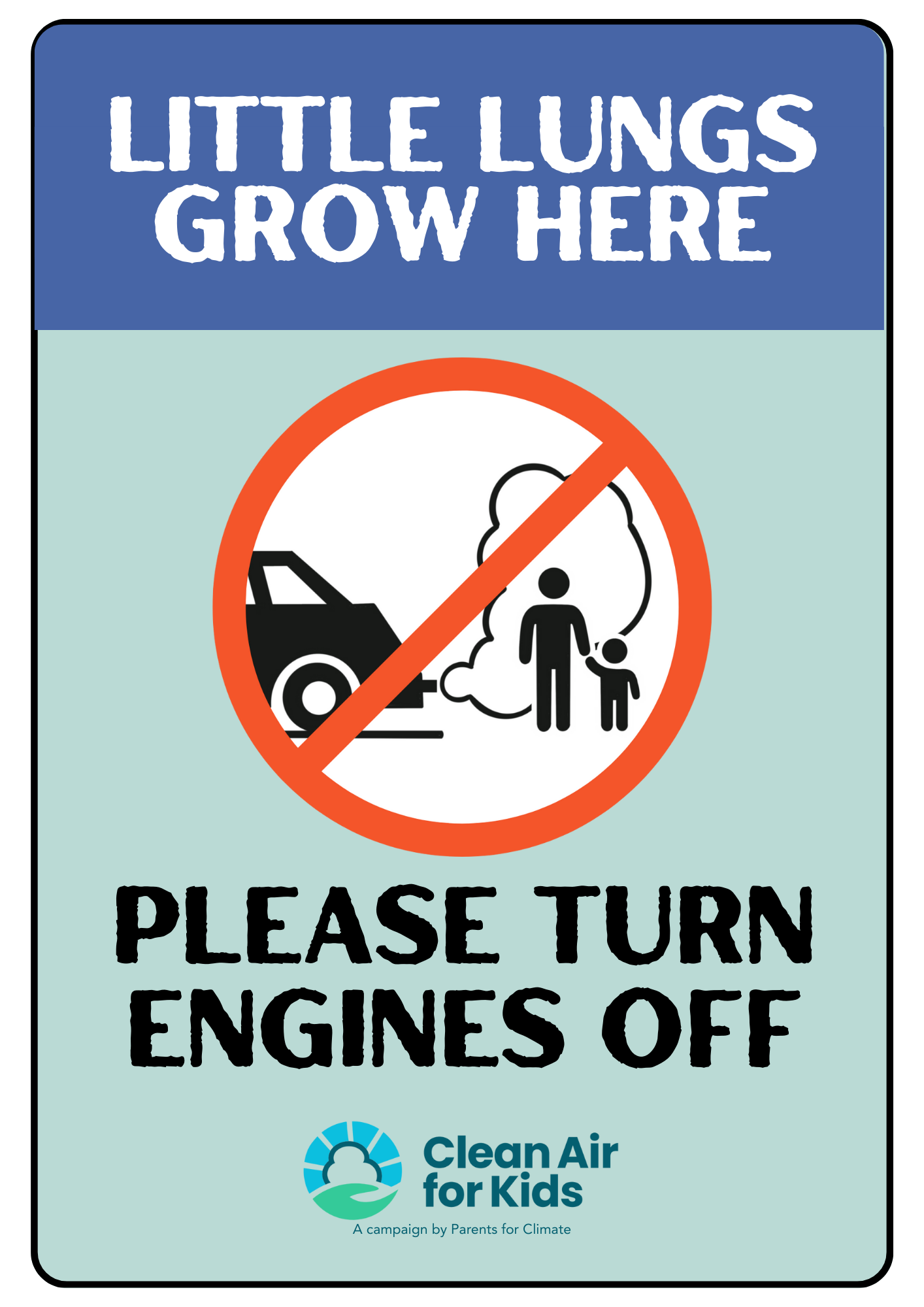
"Idle Off" is parents and doctors working together to protect kids’ health by switching engines off at school and childcare drop-off zones.
A joint initiative of Parents for Climate and Doctors for the Environment Australia.


Why Idle Off Matters
Every day, cars sit with their engines running while parked, this is called idling. Idling pollutes the air wherever it happens, but near schools and childcare centres it’s especially harmful, because children are right there, waiting, walking, playing, and breathing in exhaust at close range.
Children are most at risk
- Kids’ lungs are still developing, and they breathe more air relative to their body size than adults.
- Short-term exposure to traffic pollution can trigger asthma attacks and respiratory irritation, while repeated exposure can affect lung, heart, and brain development.
- An idling car can produce concentrated pollutants that linger at breathing height.
- Leaving an engine running near a child can be equivalent to smoking a cigarette around them.
Small changes make a big difference
- Simply turning the engine off when parked for more than a few seconds reduces harmful pollution immediately.
- It’s a simple, preventive step families and schools can take to protect children’s health.
- Internationally, schools that encourage idling reduction report measurable improvements in local air quality and awareness among parents.
Every parent can help
- Idle Off is about shared responsibility and community care - not blame.
- Small, consistent actions at pick-up and drop-off times add up to cleaner, safer air for children.
- Learn more about the research and evidence supporting Idle Off: MCF anti-idling campaign paper | Climate Council: Airborne Hazard
-
How it works
How It Works
Idle Off is designed to be simple and it starts with one small action.
Start with the pledge
Switching your engine off when you’re parked (and it’s safe to do so) helps reduce unnecessary exhaust pollution, especially in busy places where children and families are nearby.
Take the next step as a Clean Air Rep
Some parents and carers choose to help their school or childcare centre get involved too.
A Clean Air Rep is just someone who:
-
Starts a friendly conversation at their school or centre
-
Shares why reducing idling helps protect children’s health
-
Uses ready-made resources to make it easy and positive
You’ll have support the whole way
After signing up, you’ll get simple templates, tips, and step-by-step guidance — so you don’t have to figure it out alone.
Small actions add up. Every engine switched off helps protect the air our kids breathe.
Become a Clean Air Rep Today!
-
-
Laura Billings published Book Review: How To Fall In Love With The Future in Articles and media releases 2025-12-08 14:39:17 +1100
Book Review: How To Fall In Love With The Future
Author: Rob Hopkins.
Review written by Stephanie Munroe (Parents for Climate Supporter)
You’re a time traveller, eagerly stepping into the future. Climbing out of your spaceship, you look to a world where we as a civilisation did it - we turned around our march towards a doomed planet and, together, created a better world for our children and our environment. As you look out on the scene before you, what do you see? This is the pivotal question that Rob Hopkins encourages us to consider in his new book, How to fall in love with the future. In an age of climate doomism, horror stories of natural disasters, and gloomy forecasts devoid of hope, Rob challenges us to not only look towards a world where we, with our hard work and combined will, create a place where we can sigh a breath of relief, but step towards it with confidence. He presents scenarios gleaned from interviews with experts across wide and intersectional specialities on his podcast, presenting us with snippets of what could be - and why thinking this way is the first step towards putting actual boots on the ground. Better still, Rob talks us through how to conduct our own time traveller experiments in our communities - so we can bring our friends and family, our co-workers, or our local organisations along the journey with us.
Rating: 9.5/10. Half a star knocked off because I would have listened for hours to more hopeful suggestions put forth, but the selection was limited.

-
-
Laura Billings published Turning Your Driveway Into Real Climate Action in Articles and media releases 2025-11-10 16:18:14 +1100
Climate action starts right outside your front door ⚡🚗
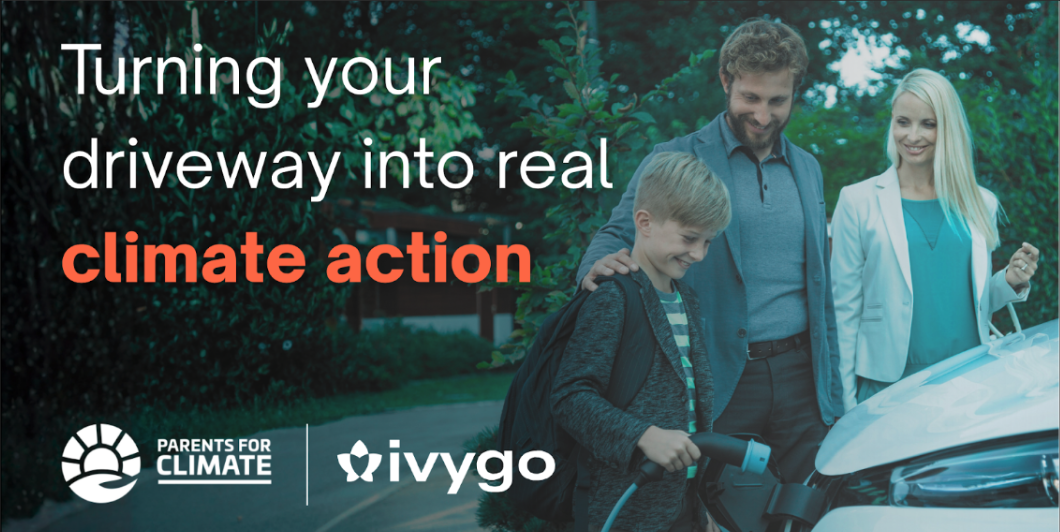
Parents for Climate has partnered with ivygo, an Australian climate-tech startup to help make the shift to electric transport fair, affordable and community powered. Together we are building a network where families share home or business EV chargers, making it easier for neighbours to drive electric while helping fund vital climate action.
 Visit ivygo.com.au/partnerships/parents-for-climate list your charger, find one nearby, or learn more.
Why it matters
Transport is set to become Australia’s biggest source of emissions, yet many families cannot easily make the switch to sustainable transport without the convenience of a home charger. More than one in three households live in apartments or rentals without off street parking, and the number is higher in high density areas. ivygo connects local drivers with nearby hosts, turning underused chargers in driveways and car parks into community hubs. Most hosts have rooftop solar, so many EVs on the platform are powered by the sun.
How you can help
Listing your charger on ivygo takes only a few minutes and is completely free. You set the hourly rate and availability that work for you, and you earn on every booking.
Use code PFCHOST when you create your listing. Each time your charger is used, ivygo donates a portion of its revenue to Parents for Climate, and you can also choose to donate your own proceeds if you wish.
It is a simple, practical way to support Australia’s shift to electric transport while funding the climate education and advocacy that protect our children’s future.
Take action today
Visit ivygo.com.au/partnerships/parents-for-climate list your charger, find one nearby, or learn more.
Questions? Contact Julie Perrissel on [email protected].
-
Laura Billings published Sense-Making in A Changing World: Podcast Review in Articles and media releases 2025-11-10 15:58:03 +1100
Sense-Making in A Changing World: Podcast Review
Author and podcast reviewer: Laura Billings
If you’re seeking a podcast that tackles the big, messy questions of our times — climate, community, systems, hope — yet does so with warmth, clarity and even a spark of joy, then Sense-Making in a Changing World is absolutely worth your time.
From the very first episode you can feel the difference: this is not just another “doom and gloom” conversation about catastrophe or only alarm. Instead, Morag leads each guest through questions about what now we can do, how we connect, how we design for the world we want – inspired by the ethics of permaculture: Earth Care, People Care and Fair Share.
What I love
-
Lightness + depth: Some topics are heavy — leadership in a changing world, economy, systems, ecology — but Morag and her guests bring a freshness. The tone feels alive and human rather than distant or dry.
-
Hope and agency: You come away from an episode feeling uplifted, ready to do something rather than paralysed. It’s like being given permission and tools to act.
-
Playful AND provocative: The conversations are not afraid to challenge us, to ask “what if?” and “how might we…” but they do so with curiosity, creativity and compassion.
-
Roots in permaculture ethics: The show honours the core permaculture values — caring for earth, caring for people, sharing fairly. That gives it a deep, grounded foundation no matter what topic is being explored.
-
Warm-hug feeling: You know that feeling when you’ve listened, the world still has problems (of course) but you feel a little lighter, connected, hopeful? This podcast creates that. It’s what makes it a 10/10 in my book.
We live in a time of complexity, overlapping crises, and a pressing need for change — personal, community, systemic. It’s easy to feel overwhelmed. This podcast offers a route through: by showing that change is possible; that different ways of thinking can open our hearts and minds; that we are not alone.
It doesn’t sugarcoat problems but it refuses to leave you stuck in them. Instead, it acts as both mirror and map: reflecting where we are and pointing to where we could go.Yes — I give Sense-Making in a Changing World a 10 out of 10. I’m deeply grateful to Morag for her kindness, compassion and clarity; for the guests who bring such imaginative and grounded conversation; and for the ripple effect of feeling lifted and energized after each episode.
If you haven’t tuned in yet — do. Your mind, heart and community will thank you for it.
Listen here: permacultureeducationinstitute.org/podcast
-
-
Petition: Protect Our Kids with Clean Air
Every child deserves to breathe clean air — to play, learn and grow without pollution harming their lungs or their future.
But right now, air pollution from traffic, gas, and coal is putting our children’s health at risk. From asthma flare-ups to long-term impacts on brain development and heart health, poor air quality is silently damaging the next generation.
Children are more vulnerable. They breathe faster, spend more time outdoors, and their small lungs are still growing. Parents, carers, grandparents and educators across Australia are standing together to say: enough is enough.
We’re calling on all levels of government, federal, state and local, to take urgent action to protect children from air pollution by cleaning up transport, phasing out gas and coal pollution, and taking strong, coordinated steps to make the air around every child cleaner and safer.
Add your name to show your support for clean air for every child, everywhere.
Together, we can create cleaner, healthier communities for our kids - today and for the future.
 Add endorsement
We, the undersigned parents, carers, grandparents, educators and community members, urge all levels of government to take urgent action to protect children from air pollution caused by transport, gas, coal and bushfire smoke.
Air pollution harms children’s health - triggering asthma, damaging lungs and affecting brain development. Kids are more vulnerable because their lungs are still growing, and they breathe faster than adults, and they spend more time outdoors.
We call on governments to:
-
Cut pollution from gas, coal and transport by accelerating the shift to clean energy, clean transport, and community-based health protection measures.
-
Protect children where they live, learn and play by reducing exposure around schools, early learning centres and playgrounds.
- Support communities and families with information, resources and health initiatives that help keep kids safe and well during periods of poor air quality.
Every child deserves to breathe clean, healthy air and protecting them must be a top priority for every level of government.
-
Cut pollution from gas, coal and transport by accelerating the shift to clean energy, clean transport, and community-based health protection measures.
-
Laura Billings published Climate Magic: podcast review in Articles and media releases 2025-10-20 16:16:58 +1100
Climate Magic: podcast review
Podcast Review by Laura Billings: Climate Magic by Sarah Jaquette Ray
I’ve been listening to the Climate Magic podcast, hosted by Sarah Jaquette Ray, author and Environmental Studies professor at Cal Poly Humboldt. The show explores how emotions like climate anxiety, grief, and hope influence our ability to take meaningful action and how even the smallest acts can feel like magic when they help us move forward.
What fascinates me most is the idea that up to 80% of our decisions are guided by emotions rather than facts or logic. When over 80% of people say they’re concerned about climate change, what’s holding us back from acting? This question has pulled me deeper into exploring the psychology of climate. How do our emotional responses shape behaviour, and how understanding this might unlock more empowered, collective action amid the “polycrisis.”
For anyone curious about how emotion and action intertwine in the climate movement, this podcast is both grounding and illuminating. Scoring it a 4.5/5
Check out the podcast: https://podbay.fm/p/climate-magic
-
Laura Billings published Growing My Own Veggies: How Food Security Sparked My Climate Journey in Articles and media releases 2025-10-20 11:40:06 +1100
Growing My Own Veggies: How Food Security Sparked My Climate Journey
I’ve never exactly been blessed with a green thumb. My grandfather grew prize-winning onions. My dad spent countless weekends nurturing a backyard full of home grown produce that could rival the local market. Even my siblings seem to have inherited the gardening gene. Me? I once celebrated keeping an indoor plant alive for 12 months.
But a few years ago, something shifted.
Watching the documentary Kiss the Ground changed how I see the world and my role in it. It was confronting to learn how fragile our food systems are, and how much industrial agriculture contributes to climate change and the degradation of our soils, an incredible natural carbon sink. But it was also hopeful, showing how regenerative farming and soil health can actually heal the planet. That film planted a seed in me (pardon the pun): if we can restore the earth on a global scale, surely I can start small right in my own backyard.
Why Growing Food Matters
My concern about food insecurity was what first motivated me to learn more about climate change. The idea that something as fundamental as food, what we feed our children, could become uncertain or inaccessible really hit home.
So, despite my less-than-stellar gardening record, I decided to create my own little patch of security: a veggie garden that was organic, local, and resilient. It wasn’t just about tomatoes and lettuce; it was about reconnecting to the cycle of care for the earth, for my family, and for our shared future.
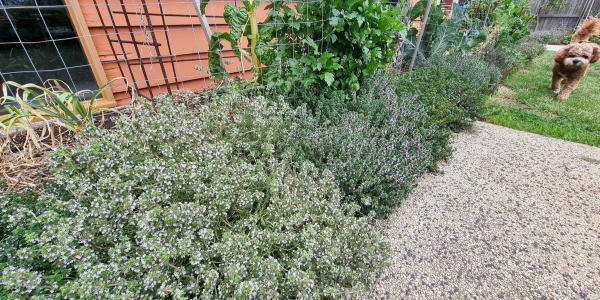
One of my veggie patches at home - thyme anyone?? Lots of thyme....Spring Gardening in Victoria
Here in Victoria, we’re lucky to live in a temperate climate zone, which means spring is a wonderful time to get growing. If you’re not sure what zone you’re in, check out this handy guide: Planting the Best Spring Crops in Australia. It’ll help you choose the right things to plant at the right time for your local conditions.
Some of my go-to spring veggies include:
🥕Carrots and beetroot – hardy, reliable, and kid-friendly.
🍅Tomatoes – the classic crowd-pleaser (even if mine still can’t match Dad’s).
🥬Lettuce and spinach – fast-growing and perfect for lunchbox salads.
🫛Beans and peas – fun for kids to plant and watch grow.
🌱Herbs - we love basil and it’s a great companion your tommy matoes:) I also avoid one of my pet peeves of having to buy food wrapped in plastic, why oh why? But that’s a topic for another blog LOL.
When planning your garden, think practical. What will your family actually eat? There’s no point in growing endless kale if it’ll just wilt in the fridge. Involve your kids in the process from picking seeds to watering and harvesting. Time and time again, I hear that even the fussiest eaters will happily eat what they’ve grown themselves.
Read more -
Laura Billings published Sign on to put kids safety ahead of politics. in Take Action 2025-09-10 11:43:48 +1000
Sign the Open Letter: Put kids safety ahead of politics.

The government’s own National Climate Risk Assessment confirms what parents across Australia already know: climate change is putting our kids and communities in danger.
As parents, we don’t take chances with our kids safety - whether it’s buckling a seatbelt, fitting a car seat, or being sun smart, we act on the best advice. We expect our government to do the same. That means shaping climate policy with science, not politics, and committing to net zero by 2035 with strong pollution cuts this decade. Anything less puts our kids' future at risk.
Add signatureDear Prime Minister and Ministers,
As parents, carers, grandparents and community members, we call on you to put the safety of our children at the centre of climate policy. The National Climate Risk Assessment highlights the escalating dangers of extreme heat, bushfires, floods, and other climate impacts. Just as parents act on expert advice to protect their children, we expect our government to act on the best available science. We urge you to adopt science-led climate policy that cuts pollution at the pace required, protects our communities, and gives every child the chance to grow up safe and healthy. Their safety cannot and should not wait.
Sincerely,
Australian parents, carers and grandparents and family members. -
Laura Billings published Common Ground - Documentary Review in Articles and media releases 2025-09-08 11:55:54 +1000
Common Ground - Documentary Review
Reviewed by: Laura, mum of 2. Member of https://www.parentsforclimate.org/geelong_bellarine_surfcoast
Watching Common Ground felt like receiving a love letter to our children’s future. After seeing Kiss the Ground, a documentary that truly changed my life, I was awakened to the layered climate and poly-crisis we face - but also shown real, tangible solutions. I was sold, and couldn’t wait for the next instalment. Common Ground didn’t disappoint. As a parent, it hit me deeply: this isn’t just about abstract environmental issues, it’s about the world our kids will inherit, and the choices we make today that will shape their lives.
The film weaves together profoundly human stories: farmers grappling with debt and despair, Indigenous leaders sharing generations of wisdom, and communities finding innovative ways to restore the land. These moments are sometimes heavy, but always grounded in hope—regenerative practices that can heal soil, restore ecosystems, and rebuild resilience. Watching it, I was reminded that we are part of nature, not separate from it, and our care matters.
Voices like Laura Dern, Jason Momoa, Donald Glover, Woody Harrelson, and Rosario Dawson add warmth and gravitas, but it’s the real-life farmers and families whose experiences stay with you. One of the most moving threads is the film’s framing as a love letter to children: a clear, urgent call to act—not out of fear, but out of love, responsibility, and hope.
Why watch it? Because Common Ground gives you both perspective and purpose. Paired with the awakening I experienced from Kiss the Ground, it shows that solutions exist, that every choice matters, and that community and connection are powerful tools for change. As a parent, it’s a reminder that the love we have for our children can—and must—drive action, creating a safer, healthier, and more hopeful future for them.
Where to Watch in Australia
You can stream Common Ground on Amazon Prime Video, available for rent or purchase. Or Apple TV.
Check-out the website for more information https://commongroundfilm.org/
-
Laura Billings published 5 Ways to Plan a Holiday That’s Kinder to the Planet (and Your Wallet) in Articles and media releases 2025-09-08 11:35:03 +1000
5 Ways to Plan a Holiday That’s Kinder to the Planet (and Your Wallet)
Holidays are about switching off, spending time with loved ones, and making memories. But they can also be heavy on emissions - from flights to accommodation to the food we eat on the road. The good news? With a little planning, you can enjoy a great trip while treading lighter on the planet.
Here are five tips (with ideas for different budgets) to get you started.
1. Rethink Your Travel Mode
Transport is often the biggest part of a holiday’s carbon footprint.
-
Budget-friendly: Take the train or coach—both are affordable and low-emissions ways to explore Australia. A rail trip from Sydney to Melbourne or Brisbane is cheaper than flying, and the views are far better than an airport lounge.
-
Mid-range: Carpool with friends or family to cut down on both costs and emissions.
-
Splurge: Hire an EV for a road trip (or even better borrow a friends or families EV for a longer than usual test drive:) . Australia’s charging network is expanding fast, making it easier than ever to explore electric.
2. Choose Low-Impact Destinations
Where you go can make a big difference.
-
Budget-friendly: Camping in national parks or staying in eco-hostels puts you close to nature with minimal footprint.
-
Mid-range: Book local B&Bs or family-run stays instead of international chains, they often support local economies and use fewer resources.
-
Splurge: Eco-lodges and certified sustainable resorts are becoming more common in Australia, offering comfort without the high carbon cost.

3. Pack Smart & Light
Less luggage means less fuel used in transport and it's less hassle for you.
-
Bring reusable water bottles, cutlery, and shopping bags to cut down on single-use plastics.
-
Pack clothes you can layer and re-wear instead of over packing.
-
If you’re flying, lighter bags mean the plane uses less fuel - every kilo counts.
4. Eat Local & Seasonal
Food miles add up quickly on holiday.
-
Budget-friendly: Visit local farmers’ markets or cook simple meals with regional produce.
-
Mid-range: Dine at local cafes and restaurants that showcase seasonal ingredients.
-
Splurge: Treat yourself to farm-to-table dining experiences or winery tours that prioritise local, low-impact produce.
5. Slow Down & Soak It In
The faster and further you travel, the higher the emissions.
-
Budget-friendly: Plan a “staycation” close to home - rediscover local hikes, beaches, and hidden gems.
-
Mid-range: Choose one region to explore deeply instead of hopping between multiple destinations.
-
Splurge: Extend your trip instead of taking multiple short getaways - one longer, slower holiday can be more relaxing and lower impact.
Final Thought
Whether you’re camping in a national park, road-tripping in an EV, or relaxing at an eco-resort, there are low-emissions options for every budget. With a little intention, your holiday can leave you refreshed—without leaving a heavy footprint.
Have you got any other tips that you would recommend to our readers? We would love to hear them email [email protected] -
-
Laura Billings published Net Zero by 2035 - For Our Kids in Articles and media releases 2025-08-11 14:23:28 +1000
Let’s Raise Our Voices for a Strong 2035 Climate Target – For Our Kids
Right now, we have a powerful opportunity to shape the kind of future our children will grow up in.
The federal government is about to decide Australia’s 2035 climate target. This is one of the most important climate decisions of the decade, and it will shape our children’s lives for years to come.
Parents for Climate is calling for a science-aligned target of Net Zero by 2035. Nothing less is safe or fair for our kids.
This target will lock in how much pollution Australia cuts over the next decade. It will decide whether our children grow up facing escalating fires, floods and heatwaves - or a safer, healthier future.
The science is clear: to keep global heating below 1.5°C and protect children from climate harm, Australia must cut pollution by at least 90% by 2035 on the way to Net Zero.
Our Perth group leader, fresh from meetings in Canberra last week, put it best:
“MPs want to hear a clear ask. They need to know the public expects strong action. And they’re watching how many of us speak up.”
This is the moment for parents, carers and grandparents across the country to raise their voices and call for a fair, fast, and science-aligned 2035 target: Net Zero by 2035.

The good news? There are numerous ways you can make the federal government feel the pressure – and every single one counts.
1. Send a letter, email, or call your ALP MP or Senator
A personal message from you can make a real impact. Let them know you expect a strong target: Net Zero by 2035.
-
Use our simple email template or key messages to contact them
- Or pick up the phone - it takes just 2 minutes, and we’ve got a step-by-step guide
Every call and email is logged, and MPs notice when numbers start to rise
2. Submit a Letter to the Editor or an Op-Ed
Local newspapers love to publish pieces from community members. Share why this matters to your family – your voice will reach both your neighbours and your MP’s office.
We’ve prepared a guide to help you write and submit your letter quickly and easily.
3. Organise or join a community photo action
Parents are gathering in parks, outside MPs’ offices, and on beaches with signs, prams, and kids to show what’s at stake.
It’s fun, family-friendly, and a powerful visual for local media – plus it shows MPs that their community is watching.
- Join an existing event, or
- Host your own – we’ll help with signs, media releases, and tips
- Here’s a How to Guide & Messaging
Inquiries email: [email protected] to get started4. Share messages on social media
Social posts get noticed by MPs – especially when they’re tagged by multiple people from their electorate.
- Share your story and use hashtags #FairFastFar, #NetZeroby2035, #ForOurKids
- Or share our social posts - check them out here: Facebook, Instagram, Linkedin
-
Tag your MP or Senator so they know this matters to local families
-
Use our simple email template or key messages to contact them
-
Tell MPs: The 2035 Climate Target Fails Our Kids’ Safety.
The government has just announced a weak 2035 climate target - one that is not aligned with what science says is needed to protect our kids from harm. The government’s own National Climate Risk Assessment makes clear the catastrophic impacts if we fail to stay within 1.5°C.
Now is a critical moment to speak up.
As a parent, your voice carries weight. MPs and Senators need to hear that we expect bold, science-aligned action: Net Zero by 2035.
💬 You’ll likely speak to a friendly staffer or leave a voicemail - that’s perfectly okay. Every message counts.
This guide will walk you through it, step by step.👉 Takes 5 minutes
📞 No experience needed
🌏 Big impact for our kids’ future
Step 1: Find your Labor MP, Senator or duty senator
Use this tool to quickly find a phone number for your Labor MP or nominated ALP Senator (for electorates without a Labor MP) - just search by your electorate.
Find your MP/Senator with this tool
SPLIT
Step 2: Make Your Call - With Script or Talking Points
You’ve found your MP or Senator’s number - now it’s time to make the call. Use the calling script or talking points below for pointers.
Whether you prefer a full script or just a few key points to guide you, we’ve got you covered.
Your Key Message (say this no matter what)
"I’m calling to express my disappointment that the government’s 2035 climate target fails the child safety test. This target exposes our kids to escalating climate risks, and we cannot ignore the science."
This is the #1 thing to communicate - it frames the decision as failing children’s safety, and clearly conveys urgency and concern to MPs.
Calling script (make it your own)
Hi [MP/Senator’s Name], I’m [name], a parent/carer/grandparent from [location]. I’m calling because the 2035 climate target fails the child safety test. As a [parent/carer/grandparent] we follow the best available science in order to keep our children safe, we believe that the government has the same duty of care and may have a legal obligation to do the same.
I was [emotional reaction] to read the findings of the risk assessment, we cannot ignore the science. I urge the Labor government to adopt science-led climate policy that cuts pollution at the pace required, protects our communities, and gives every child the chance to grow up safe and healthy.
[Optional: Share your story – e.g., “I have two kids, and by 2035 they’ll be 10 and 12. I want them to grow up in a world that’s safe and stable.”]
I ask [politicians name] what are they going to do to keep our kids safe? to convey this message to the labor cabinet and ask them to reconsider. We have so much to gain and everything to lose.
Please pass on my message - and thank you for your time.
(Optional) I’d appreciate a response outlining [MP/Senator’s Name]’s position. You can reach me on [Phone] or [Email].
Talking Points
Just hit the key points in your own way - you don’t have to be perfect!
1. Introduce yourself
"Hi [MP/Senator’s Name], I’m [name], a parent/carer/grandparent from [location]."2. Frame the problem / concern
"I’m calling because the announced 2035 climate target fails the child safety test. As a parent/carer/grandparent, we follow the best available science to keep our children safe - we believe the government has the same duty of care, and may even have a legal obligation to do the same."3. Share your emotional response & urgency
"I was [shocked / heartbroken / alarmed] to read the findings of the National Climate Risk Assessment. We cannot ignore the science - our kids’ safety and future are at stake."4. Share your 'why'
"This matters to my family because… [my kids will be 15 and 17 by 2035 / we’re already seeing impacts in our community / I want my grandkids to live in a safe climate]."5. Make the ask / prompt action
"I urge the Labor government to adopt science-led climate policy that cuts pollution at the pace required, protects our communities, and gives every child the chance to grow up safe and healthy. What will you do to keep our kids safe, and convey this message to the Labor Cabinet to reconsider the target? We have so much to gain and everything to lose.TIP: Speak from the heart - your voice matters. If you're nervous, you're not alone - but together, we're powerful.
Call Script or Talking Points for The Prime Ministers Office and Key Ministers
- Prime Minister - (02) 6277 7700 or (02) 9564 3588
- Climate and Energy Minister Chris Bowen - (02) 6277 7120
- Assistant Minister Climate and Energy Josh Wilson - (02) 6277 2081
- Environment Minister Murray Watt - (07) 5531 1033
- Resource Minister Madelaine King - (02) 6277 7930
- Treasurer Jim Chalmers - (02) 6277 7340
- Education Minister Jason Clare - (02) 6277 7350
Call Script PM & Ministers
Hi [Prime Minister/Minister’s name], I’m [name], a parent/carer/grandparent from [location]. I’m calling because the 2035 climate target announced by the government fails the child safety test.
As a [parent/carer/grandparent], I follow the best available science to keep my children safe. I believe the government has the same duty of care - and a responsibility to show leadership in these challenging times.
I was [emotional reaction] to read the findings of the National Climate Risk Assessment. We cannot ignore the science. It shows the risks of fires, floods, and heatwaves - and makes clear that the cost of inaction, or even inadequate action, is far greater than acting decisively now.
I urge you to show courageous leadership by strengthening Australia’s climate response - reassessing the 2035 target and ending approvals for new coal and gas projects. This is about guiding us safely through uncertain times, and shaping a future Australians can be proud of.
Our kids didn’t choose this crisis, but they will live with its consequences. What will your legacy be - leaving them exposed, or leading us to safety?
Please pass on my message - and thank you for your time.
Quick Talking Points (for PM & Ministers)
-
Introduce yourself: “I’m a parent from [suburb], and I care deeply about our kids’ safety.”
-
Express concern: “The 2035 target fails the child safety test.”
-
Leadership: “In these times, we need leaders who follow science and protect children’s futures.”
-
Cost of inaction: “The risks - and costs - of inaction are far greater than acting decisively now.”
-
Call to action: “Reassess the target and stop approving new coal and gas.”
-
Legacy: “What will your legacy be - leaving kids exposed, or leading us to safety?”
Step 4: Tell us who you called - it helps us track momentum
Your action matters. By letting us know who you called, we can:
- Keep track of which electorates have been contacted
- Show decision-makers how many parents are raising their voices
-
Follow up strategically with MPs/Senators
Please fill in this quick form:
-
Laura Billings published Review: The Hidden Life of Trees in Articles and media releases 2025-07-03 17:09:33 +1000
Documentary Review: The Hidden Life of Trees
Reviewed by: Laura Billings
Watching The Hidden Life of Trees was like stepping into a secret world that’s been quietly thriving all around us—one I had barely begun to understand. Based on Peter Wohlleben’s beautiful book, the documentary takes you on an incredible journey beneath the forest floor and into the intricate, surprising, and deeply connected lives of trees.
The cinematography is next level—lush, immersive, and profoundly moving. But it’s the storytelling that really hit me. Trees as communicators. Trees as caretakers. Trees as a community that feels, remembers, even supports one another. It’s mysterious, creative, patient, loving—a bloody miracle, really.
After watching, I genuinely couldn’t look at a tree the same way again. My appreciation for this living ecosystem we’re a part of deepened tenfold. It reminded me how much wisdom is held in the natural world—and how much we stand to lose if we forget our connection to it.
It’s a documentary that inspires awe, reconnects you with nature, and stirs a quiet kind of hope. I can’t recommend it enough. 10/10
You can watch The Hidden Life of Trees in Australia through a few streaming platforms:
Amazon Prime Video: Available for rent or purchase.

-
Moving Your Money: One of the Most Powerful Climate Actions You Can Take
When we think about climate action, we often think of solar panels, reducing waste, or joining a local campaign. But there’s one powerful action you can take right now—without even leaving your house—that can have an enormous impact on your child’s future:
👉 Move your money out of banks and super funds that finance environmental destruction.
Many of Australia’s biggest financial institutions are still investing in industries that threaten a safe future for our kids—from fossil fuel expansion, to large-scale deforestation, land clearing, and other environmentally harmful projects.
It’s not just about emissions. It’s about protecting the forests, water, and natural systems that all life depends on—and that our children are set to inherit.
As parents, carers, and grandparents, we want to give our kids a future full of possibility—not one undermined by the very institutions meant to protect our savings. The good news? Moving your money is one of the most powerful and effective climate actions you can take.
🏦 So, what’s my bank or super fund actually doing?
Even though they may offer feel-good sustainability statements, many of Australia’s biggest financial institutions are still pouring billions into environmentally destructive industries—funding not just fossil fuel expansion, but also deforestation, unsustainable agriculture, and other projects that undermine a safe future for our kids.
Thankfully, our friends at Market Forces have done the heavy lifting for you.
Use their tools to compare your current bank or super fund:
-
Compare banks: marketforces.org.au/compare-bank-table
-
Compare super funds: marketforces.org.au/superfunds
You’ll find clear, independent information on which institutions are financing harmful industries—and which are helping fund a safer, more sustainable future.
🔄 It’s easier to switch than you think
Once you know what your bank or super fund is supporting, you can:
- Ask them to change their investment practices
- Move your money to a more ethical institution
- Encourage other parents, schools, and community groups to do the same
Many parents in our community have made the switch—and it feels good to know that your hard-earned savings are building a better world, not funding its destruction.
🌱 Why this matters for parents
As Market Forces puts it: "Finance is the key lever to hold companies accountable for the environmental harm they cause."
This isn’t just a technical change—it’s a values-driven decision. When we move our money, we’re sending a clear message: we won’t let our children’s future be bankrolled away.
And when we do it together? That message is impossible to ignore.
📣 Ready to take action?
Head to Market Forces and check out how your bank and super stack up. Then take the next step that feels right for you—switching, speaking out, or sharing with others.
Because change doesn’t just come from the top down—it comes from the power of everyday parents, moving together. 💚
-
Compare banks: marketforces.org.au/compare-bank-table
-
Laura Billings published The Ocean Is My Happy Place — And It Needs Our Help in Articles and media releases 2025-06-05 14:31:18 +1000
The Ocean Is My Happy Place — And It Needs Our Help
There isn’t a day that goes by where I don’t feel deeply grateful to live by the ocean. It’s my happy place. It’s where I go to play with my kids, walk off a tough day, or find a moment of peace. It’s where I feel most grounded — and most alive. Whether I’m swimming, floating, or simply watching the waves roll in, the ocean always brings me back to myself.
Living in an oceanside town, I’m constantly reminded of how generous the ocean is. It gives us food, regulates our climate, supports entire ecosystems — and it’s literally the lungs of the planet. Did you know that the ocean produces over 50% of the oxygen we breathe? It absorbs about 30% of the carbon dioxide we emit, buffering us from the worst impacts of climate change. And it’s home to the greatest biodiversity on Earth — though we’ve only discovered a fraction of the species it holds.
For many Australians, the ocean is part of our identity. It shapes our summers, our childhood memories, and for many First Nations communities, it is sacred — a source of cultural knowledge, story, and stewardship going back tens of thousands of years.

But even something as vast as the ocean is not immune to harm.
Rising temperatures are bleaching our coral reefs. Plastic pollution is choking marine life. Fertiliser runoff and oil spills damage fragile ecosystems. Our clothes shed microplastics that flow straight from washing machines to the sea. Warming, acidification, biodiversity loss — the signs of a declining ocean health rating are everywhere, and they’re deeply connected to human activity.
So what can we do?
There’s a lot we can do — starting right at home:
🌊 Don’t litter — ever. Most street rubbish ends up in stormwater drains, which lead straight to the ocean.
🌊 Use reef-safe sunscreen. Some common ingredients are toxic to coral and marine life.
🌊 Be mindful of your washing. Wash clothes less often, use a microfibre-catching laundry bag, and choose natural fabrics to reduce microplastic pollution.
🌊 Reduce single-use plastics. Reuse, refill, and refuse where you can.
🌊 Respect coastal ecosystems. Stay on paths, avoid disturbing wildlife, and take only photos.
🌊 Join a local group. From Coastcare to other local coastal community groups, there are brilliant community efforts restoring coastlines and protecting marine habitats.
🌊 Support climate action. Fossil fuels aren’t just warming the atmosphere — they pollute our oceans too. Join organisations like Parents for Climate who are pushing for a fast, fair transition to clean energy.
🌊 Speak up. Our oceans need policies that match the scale of the crisis. Add your voice to campaigns, vote for climate, and help shift the tide.

The ocean is resilient. If we act now — with urgency and love — it can heal. We can protect it for our kids and for every living thing that depends on its life-giving magic.
This World Ocean Day (and every day), let’s celebrate the wonder of our oceans — and honour them with our care.
Because the ocean gives us so much.
And now, it’s our turn to give back.Written by Laura Billings - living, working and playing on majestic Wadawurrung Country.
-
Download the Carbon Claims and Integrity Toolkit
Updated for the closure of Climate Active
In July 2026, the Australian Government confirmed it will close Climate Active and stop certifying voluntary "carbon neutral" claims. Certification, the Climate Active trade marks, the term "carbon neutral" for voluntary claims and the register of consultants will all be discontinued, with a transition period for currently certified businesses.
If your organisation has relied on Climate Active certification, or advises those who do, the ground has shifted. Hundreds of certified businesses now need to work out what they can and can't say. And the fallback of pointing to a government trade mark is disappearing.
This toolkit is built on the only Australian case to test "carbon neutral" product marketing in court: Parents for Climate v. EnergyAustralia. It sets out:
- a summary of the settlement and what EnergyAustralia conceded
- the problems with marketing based on offsetting and "carbon neutral" language
- what companies should and shouldn't say to avoid greenwashing
As Equity Generation Lawyers put it when the closure was announced: "Companies that have relied on this label should take note. The legal and reputational risks of 'carbon neutral' claims based on offsetting are only growing."
A practical resource for communicators, campaigners, legal advisers and sustainability teams navigating the transition.
This is a Toolkit for Communicators, Campaigners & Legal Advocates, based on the Federal Court case settlement: Parents for Climate v. EnergyAustralia.

Plus gain access to the recording of a special 1-hour online briefing that brought together legal, media, and campaign experts to unpack the impact and implications of the Parents for Climate v. EnergyAustralia greenwashing settlement.
Fill out the download form to get your copy in your 💌 inbox now
The toolkit supports clear, responsible, and legally sound communication about climate claims based on offsetting.
It sets out:
- a summary of the settlement
- issues with marketing based on offsetting and ‘carbon neutral’ language; and
- what companies should and shouldn’t say to avoid greenwashing.
It helps you avoid greenwashing and build public trust.
Sign up
-
Laura Billings published Where To Start on Home Electrification in Articles and media releases 2025-04-08 17:10:59 +1000
Where To Start on Home Electrification
Thinking about switching your home to all-electric but not sure where to begin? You’re not alone — more and more families across Australia are considering making the move away from gas and towards cleaner, healthier, and more cost-effective electric homes.
Electrifying your home doesn’t have to happen all at once. In fact, it’s often easier (and cheaper) to take it step by step. Here's a simple guide to help families get started:
🔌 1. Start with the "Big Five" Appliances
When we talk about electrification, we’re usually referring to replacing five major things in the home:
-
Gas cooktop → Induction stove
-
Gas water heater → Heat pump hot water system
-
Gas heater → Reverse cycle air conditioner
-
Petrol car → Electric vehicle (EV)
-
Rooftop solar + battery (to power it all)
Don’t worry if you can’t do them all right away — just consider electrifying when it’s time to replace an old or broken appliance. Each step makes a difference.
💰 2. Look Into Rebates and Incentives
There’s good news: Governments are starting to roll out more support to help households make the switch.
For example, the newly announced federal Labor government battery rebate means you could save 30% on the upfront cost of installing a home battery from July 1, 2025 — potentially cutting your bills by up to $2,300 per year!
State governments also have programs and rebates for solar panels, heat pumps, and energy-efficient appliances. Check what’s available in your area before you buy.
🛠️ 3. Make a Home Energy Plan
Before jumping into upgrades, it’s helpful to:
-
Get a home energy assessment (some councils offer this for free!)
-
Understand your current energy use
-
Prioritise upgrades based on what will make the biggest impact for your family’s comfort and bills
A local, trusted electrician or energy advisor can help you map out a plan that fits your budget and lifestyle.
🌱 4. Talk to Your Kids About It
Electrifying your home is a great way to show your kids how everyday choices can help the planet. It can spark conversations about climate solutions, energy, and how we can create a safer future together.
Bonus: Kids love induction cooktops. They’re like magic!
🤝 5. Connect With Others on the Same Path
You don’t have to do this alone. There are Facebook groups, community forums, and local events where people share tips, recommendations, and stories about their electrification journeys.
If you're part of a Parents for Climate local group, reach out — many families are making the switch and happy to help each other out.
Read more -
-
Protect our kids - No New Coal and Gas
Our kids deserve clean air, safe homes, and a better tomorrow. But new coal and gas projects threaten their future.
Right now, fossil fuel expansion is putting Australian families at risk - polluting the air our children breathe, driving up energy costs, and making extreme weather events worse.
We can choose a different future. One where families have healthy, affordable energy and a safe climate to grow up in.
It starts with raising our voices and showing up for what matters. Every voice strengthens the call for real action.
✅ Sign the petition to demand NO NEW COAL AND GAS and protect what we love.
👉 Stand up for clean air and a healthy future. Order a free yard sign here – every sign on a lawn is a signal of hope and a reminder that parents and carers everywhere are ready to protect what we love.
 Add signature
To Prime Minister Anthony Albanese, Chris Bowen MP - Minister for Climate and Energy, and Murray Watt - Minister for the Environment,
I am deeply concerned about the continued expansion of coal and gas projects in Australia. New fossil fuel projects threaten our children's future - polluting the air they breathe, contributing to rising household costs, and accelerating the climate crisis.
I call on you to commit to:
🚫 No new coal and gas projects in Australia
🌱 Investment in clean, affordable energy that benefits all families
🏡 A safe climate for all kids to thriveOur kids deserve better. Later is too late. Act now.