The carbon offsets industry is like the Wild West. It's comprised of both voluntary markets run by for-profit exchanges, alongside government markets like Australian Carbon Credit Units or ACCUs. The Australian government market was the subject of a federal review following substantial accusations of fraud, including offsets schemes that are actually resulting in emissions increases(!). The review, led by Ian Chubb, the former Chief Scientist, was by all accounts a misfire. And here’s why.
The devil in the (boring) detail
The Wild West comparison belies the sad truth about offsets, namely that they are generally quite boring. I’ve had to learn more about them to write this article; there I am of an evening, sitting up in my bed Googling and the next thing you know it’s the morning and I’ve had a good night’s sleep. So I suppose it’s not all bad.
Precisely because of their inherent complexity there is potential for industries to use offsets to avoid making genuine reductions. No doubt corporate lawyers like them. Convoluted, difficult to measure and enforce, with lots of opportunity for small print, carve outs and sidestep; there is wriggle, wriggle, wriggle room a-plenty for those fine legal minds to nerd out on. They can easily become window-dressing, a get-out-of-jail-free card.
The bottom line is that not all offsets and credits are created equal and some basic principles should not be broken.

If only it were that easy to label all carbon offset schemes.
1 pollution unit here + 0 emissions there does not = 0 impact
With some offsets, you’re paying for someone else to avoid emitting. But that doesn’t cancel out your own emissions: your 1 + their 0, still = 1. And anyway, was their “non-emission” additional to the status quo? If you’ve paid someone to not cut down a forest destined to be felled, how do you know if they were really planning to cut it down anyway? Or, maybe they were, and by you paying them not to cut down that particular forest, they’ve cut down a different forest instead. That’s called leakage; a technical term if ever there was one.
On the other hand, if you’re paying someone to plant a forest, or capture carbon in soils by changing the way a farmer tills a field, then maybe you are removing emissions from the atmosphere: your 1 minus the 1 they sequester in a tree or soil = 0 (in theory). That sounds more like carbon neutrality.
See what I mean by convoluted? For me it helps to break down the word itself: ‘off’ and then ‘set’. Meaning do a negative thing then set it off against a positive thing. But why not just stop doing the negative thing in the first place? If someone shoots you in the left foot, should you feel grateful they haven’t shot you in the right foot too?
What happens when different types of offsets are treated the same way?
The varieties of carbon offsets can be judged in how effective they are for genuine emissions reductions, but also in what sort of legacy they leave behind. Nature-based offsets, like rewilding, can provide us with clean green spaces to reconnect with nature, breathe fresh air and teach our children the value of living things. Other less-reliable offsets - like the pipe dream that is carbon capture and storage – are at high risk of becoming stranded assets and technological monstrosities to boot. Societal benefits created by an offset scheme should not be an afterthought but a priority.
Another tricky part is that we must consider the whole lifecycle of both emissions and offsets. Carbon dioxide hangs around in the atmosphere between hundreds and thousands of years. Pretty much everything we’ve emitted since the start of the industrial revolution is still up there. So a carbon offset is only useful if it permanently removes carbon. What happens if the new trees in a carbon sequestration forest die in a drought or are burnt in a bushfire? What happens if the farm is sold and the new owner reverts to methods that let the captured carbon out of the soil? Or a flood erodes the land, which might also release the carbon? Natural carbon stores are vulnerable.
Coordination of measurement and enforcement must be strict; if someone’s planted a forest, but a company then claims that carbon against its emissions, which in turn gives them license to continue to emit at the same level, that does not make a genuine reduction.
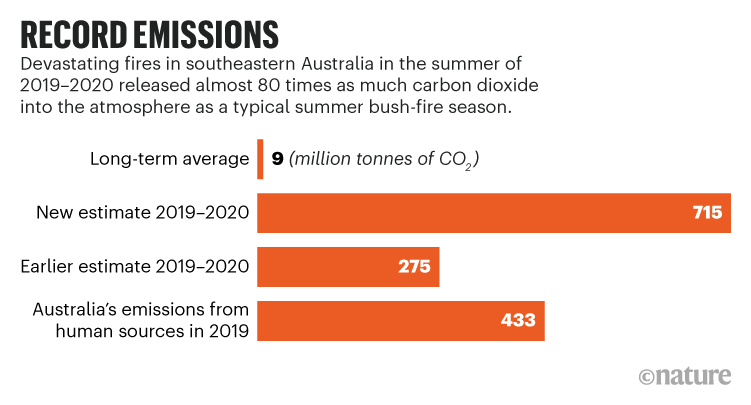
Bushfires pose a major threat to the permanence of carbon offset schemes reliant on forestry. Source: Ref. 1/M. Crippa et al. ‘Fossil CO2 emissions of all world countries: 2020 report’ (European Commission Joint Research Centre, 2020).
Offsets only make sense as a last resort
We can’t continue polluting as usual, let alone start new projects, then buy any old “offsets” to cancel out the impact of that pollution. Offsets were only ever intended to be the last resort. To quote a famous movie line, you can’t “cut 'em in half with a machine gun and give 'em a band-aid”. We can’t offset our way to net zero because there aren’t enough genuine offsets available: additional, permanent, removal-based, backed by robust, long term measurement, reporting and verification.
Greenwashing is rife today and the past behaviour of the fossil fuel industry – disinformation, obfuscation, denial and delay - has hardly been exemplary. So the burden of proof must be high. Certification must be hard to achieve and maintain. Disclosure must be full, detailed and of high integrity. Governments must design, test, enforce and then adjust offsets policies over a very long period of time to make sure they are working as intended and the industry plays their part.
At this late hour, the scale of the problem and the levels of emissions are so great – dare I say planetary - that the main focus must be to reduce or stop current emissions altogether and as quickly as possible, starting with the biggest emitters first. Because nothing less will secure a safe climate for our kids.
You can add your voice to our campaign for strong rules for Australia's biggest producers of carbon pollution here: https://www.ap4ca.org/safeguardourkids
Share this article: